Wednesday, December 22, 2010

CoroCall - Affordable high-definition video and audio conferencing

With CoroCall you can be anywhere, anytime...

 
CoroCall can connect users with varying devices


CoroCall group HD videoconferencing connects 2 to 20 or more attendees together with PCs, Macs or video conferencing room systems like Vidyo, Polycom, Cisco/Tandberg, and LifeSize.
 

CoroCall can be used on just about any network.
  CoroCall uses standard broadband networks, including 3G wireless or satellite links to quickly connect people globally; you can CoroCall with someone working from a hotel or riding on a train in India, China, Europe, North America and Latin America.
 

CoroCall will save you money, time and more...


Using CoroCall saves many of our customers 30% or more of their travel budget. Whether you're a small company looking for an affordable monthly service for customer support, or a large organization wanting to extend your current video conferencing solution, CoroCall has what you need.

Plans starting under $35 per month.


Do you think this is good for our space? Comments please

Tuesday, December 21, 2010

Al Franken: The Most Important Free Speech Issue of Our Time

This Tuesday is an important day in the fight to save the Internet.

As a source of innovation, an engine of our economy, and a forum for our political discourse, the Internet can only work if it's a truly level playing field. Small businesses should have the same ability to reach customers as powerful corporations. A blogger should have the same ability to find an audience as a media conglomerate.

This principle is called "net neutrality" -- and it's under attack. Internet service giants like Comcast and Verizon want to offer premium and privileged access to the Internet for corporations who can afford to pay for it.

The good news is that the Federal Communications Commission has the power to issue regulations that protect net neutrality. The bad news is that draft regulations written by FCC Chairman Julius Genachowski don't do that at all. They're worse than nothing.

That's why Tuesday is such an important day. The FCC will be meeting to discuss those regulations, and we must make sure that its members understand that allowing corporations to control the Internet is simply unacceptable.

Although Chairman Genachowski's draft Order has not been made public, early reports make clear that it falls far short of protecting net neutrality.

For many Americans -- particularly those who live in rural areas -- the future of the Internet lies in mobile services. But the draft Order would effectively permit Internet providers to block lawful content, applications, and devices on mobile Internet connections.

Mobile networks like AT&T and Verizon Wireless would be able to shut off your access to content or applications for any reason. For instance, Verizon could prevent you from accessing Google Maps on your phone, forcing you to use their own mapping program, Verizon Navigator, even if it costs money to use and isn't nearly as good. Or a mobile provider with a political agenda could prevent you from downloading an app that connects you with the Obama campaign (or, for that matter, a Tea Party group in your area).

It gets worse. The FCC has never before explicitly allowed discrimination on the Internet -- but the draft Order takes a step backwards, merely stating that so-called "paid prioritization" (the creation of a "fast lane" for big corporations who can afford to pay for it) is cause for concern.

It sure is -- but that's exactly why the FCC should ban it. Instead, the draft Order would have the effect of actually relaxing restrictions on this kind of discrimination.

What's more, even the protections that are established in the draft Order would be weak because it defines "broadband Internet access service" too narrowly, making it easy for powerful corporations to get around the rules.

Here's what's most troubling of all. Chairman Genachowski and President Obama -- who nominated him -- have argued convincingly that they support net neutrality.

But grassroots supporters of net neutrality are beginning to wonder if we've been had. Instead of proposing regulations that would truly protect net neutrality, reports indicate that Chairman Genachowski has been calling the CEOs of major Internet corporations seeking their public endorsement of this draft proposal, which would destroy it.

No chairman should be soliciting sign-off from the corporations that his agency is supposed to regulate -- and no true advocate of a free and open Internet should be seeking the permission of large media conglomerates before issuing new rules.

After all, just look at Comcast -- this Internet monolith has reportedly imposed a new, recurring fee on Level 3 Communications, the company slated to be the primary online delivery provider for Netflix. That's the same Netflix that represents Comcast's biggest competition in video services.

Imagine if Comcast customers couldn't watch Netflix, but were limited only to Comcast's Video On Demand service. Imagine if a cable news network could get its website to load faster on your computer than your favorite local political blog. Imagine if big corporations with their own agenda could decide who wins or loses online. The Internet as we know it would cease to exist.

That's why net neutrality is the most important free speech issue of our time. And that's why, this Tuesday, when the FCC meets to discuss this badly flawed proposal, I'll be watching. If they approve it as is, I'll be outraged. And you should be, too.


Friday, December 17, 2010

The Ann Arbor Chronicle » Active Use of Work Space: Film Premiere

On Wednesday night at the Workantile Exchange – a membership-funded coworking space on Main Street, between Washington and Huron – local video producer and urban researcher Kirk Westphal premiered his two newest films.

Workantile Exchange Urban Planning Council Manager Form of Government

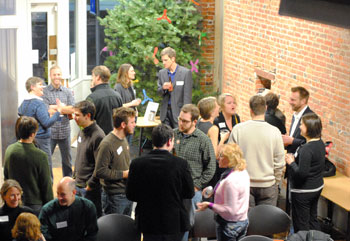
Pre-premiere socializing at the Workantile Exchange for films on urban planning and forms of local government. (Photos by the writer.)

The first film, “The Great Street Toolkit,” focuses on urban planning. The second, “The Council-Manager Form of Local Government,” is an introduction to how the council-manager system is different from a strong mayor system. The city of Ann Arbor uses a modified version of the council-manager form.

As Westphal himself noted lightheartedly, it was the “true wonks” in the audience who stayed for the second film – on council-manager government.

And it turns out that most of the 30 people in the audience were true wonks.

But linked indirectly to the evening in multiple ways was one person who was not in the audience at all –  local developer and downtown property owner, Ed Shaffran.

The wonks included people like Wendy Rampson, head of planning for the city of Ann Arbor; Ed Koryzno, Ypsilanti’s city manager; Diane Giannola, Ann Arbor city planning commissioner; Doug Kelbaugh, former dean of the University of Michigan’s Taubman College of Architecture and Urban Planning; and Steve Bean, recent independent candidate for mayor of Ann Arbor.

Doug Kelbaugh Wendy Rampson Urban Planning

Doug Kelbaugh, former dean of the University of Michigan College of Architecture and Urban Planning, talks with Wendy Rampson, head of Ann Arbor's planning staff.

Westphal, a video producer and urban researcher, will be recognizable to many Chronicle readers as one of the city’s planning commissioners; he also serves on the city’s environmental commission. His previous work includes the film “Insights into a Lively Downtown,” a case study of Ann Arbor.

Each of Westphal’s new films had a running time of 23 minutes, and there was opportunity for the audience to discuss the content of the films before, between and after the showings. Prompting much of the discussion was how the material in the “Great Street” film relates to the Washington-to-Huron block of Main Street, where the Workantile Exchange itself is located. The Washington-to-Huron block includes a number of banking opportunities: Citizens Bank, Chase, KeyBank, and PNC Bank. In addition, Comerica is located just north of Huron, in the One North Main building.

But as the “Great Streets” film makes clear, neither professional planners nor Westphal are fans of banks as a ground-floor use in a downtown environment. [The film was funded in part by a grant from the Urban Design and Preservation division of the American Planning Association.]

Westphal has expressed the same view before, most recently in an early November presentation he made to his colleagues on the planning commission. Describing a surveillance camera photo of a bank robbery in progress, said Westphal: “What I’d like to convince you of tonight is that there are two crimes being committed in this photo. I contend that what this thief is stealing from the bank doesn’t even come close to what underused banks, like this one, steal from the vitality of a downtown.”

westphal-as-credits-roll

Kirk Westphal answered questions as the credits rolled.

And in an opinion piece published in the April 5, 2009 Ann Arbor News, Westphal expressed the general view that ground floor uses should be regulated in the zoning code to give preference to “active uses” – like retail stores, cafes and restaurants.

So how did Ed Shaffran factor into the evening?

When Westphal’s opinion piece was published in The News, it appeared side-by-side with one from Shaffran, who’s a downtown property owner and developer, and who offered a view opposing Westphal’s. From Shaffran’s piece: “On a theoretical level, to say a bank is not an active use and should be located to a secondary street borders on National Socialism.”

The impetus for the two opinion pieces was the city’s A2D2 rezoning initiative for downtown Ann Arbor, which at the time was being debated by the city council. The original A2D2 proposal included some restrictions on ground-floor uses in certain areas – preference was given to active uses. But those restrictions were removed from the version of the A2D2 rezoning that was approved by the Ann Arbor city council in November 2009.

And Shaffran, as it turns out, was featured in a serendipitous cameo in Westphal’s “Great Streets” film, which included footage shot by Westphal in downtown Ann Arbor. In the frame, Shaffran can briefly be seen walking towards the camera east along Liberty Street, talking on his cell phone.

Jesse Bernsetin, Ray Detter

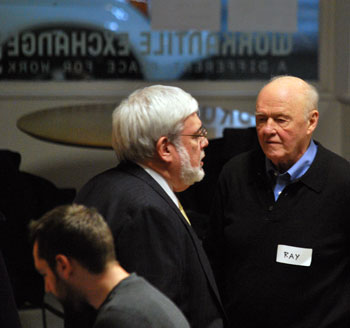
At left: Jesse Bernstein, chair of the board of the Ann Arbor Transportation Authority, chats with Ray Detter, president of the Downtown Citizens Advisory Council, before the film premiere. In the foreground is Trek Glowacki, co-owner of the Workantile Exchange.

Another Shaffran connection to the film premiere: He owns the building at 118 Main St. that houses the Workantile Exchange, where the films were shown.

And it was the Workantile Exchange itself that generated some of the conversation after the “Great Streets” showing. Why? Parade examples of non-active uses of space are banks and offices. And the coworking space offered by the Workantile Exchange is somewhat similar to shared office space. Does coworking space constitute an active use in an urban planning sense?

The day before the showing, Trek Glowacki, co-owner of the Workantile Exchange, explained to The Chronicle that one key difference between a coworking space and a shared office arrangement is the business model. In a shared office space, every tenant would have an assigned desk, and the rent for the space would be divided equally among the tenants. If a tenant moves out, the remaining tenants would pay slightly more rent. If tenants were added, the rent would decrease accordingly.

In contrast, the Workantile’s coworking space doesn’t guarantee a permanent desk in a specific location. The furniture is on wheels, and will be configured differently on any given day, depending on who shows up to work, when they show up, and who they might be collaborating with. The Workantile is calibrated to a culture that is inherently more collaborative than an arrangement where the only expectation is that you pay the rent for your desk. This community of coworking is a key part of what Glowacki describes as the Workantile’s role in the city’s economic development.

So, the monthly fee paid to the Workantile is not a desk rental, but rather a membership that gives access to a working community and the expectation of a contribution to that community. The space itself includes all the typical amenities that you’d expect in an office, including access to two conference rooms.

Workantile Exchange WIndow

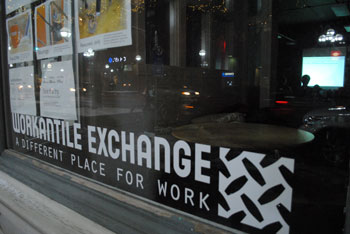
Window view of the Workantile Exchange last Wednesday night.

The configurable space inside the Workantile makes it suitable for hosting various kinds of events. For example, on Friday, Dec. 3, the same day as Midnight Madness in downtown Ann Arbor, author David Erik Nelson, a Workantile member, hosted a book-signing event for his latest title, “Snip, Burn, Solder, Shred.” The book is written for parents who’d like to make things with their kids – like boomerangs. With all the tables rolled to the walls, there was plenty of room to fling the boomerangs around the main floor. The Workantile Christmas tree is now bedecked with boomerangs.

And of course the space is suitable for hosting a film premiere.

So one of questions at the conclusion of the film came from the Workantile’s Glowacki, who told Westphal to be honest: Is the Workantile Exchange an active use of space?

Before answering, Westphal wanted some clarification about what the usage patterns were. Glowacki told him there was generally someone working 20 hours out of every day. Westphal noted that the use was certainly more active when Mighty Good Coffee had its storefront at the front of the space – but in September 2010 Mighty Good moved up the block to a new location at 217 N. Main St. Now, the whole space is occupied by the Workantile.

At a meeting of Workantile coworkers soon after Mighty Good Coffee departed, they discussed possible alternatives for the area previously used by the coffee shop’s store front. One idea batted around at the meeting was rotating window displays showing off the work of members. Attractive windows offering things of interest to pedestrians is one feature that Westphahl’s “Great Streets” film highlighted as important for a vibrant downtown.

From outside the Workantile on Wednesday night, the film premiere taking place on the other side of the glass wasn’t necessarily accessible to every member of the public – the sign on the door indicated a private event was taking place. But through the window it was clear the space was filled with activity.

Dave Askins, editor and co-founder of The Chronicle, is a member of the Workantile Exchange.

Section: Business, Govt.

The following terms describe the content of this article. Click on a term to see all articles described with that term: , , , , , ,

Copyright 2010 The Ann Arbor Chronicle.

Thursday, December 16, 2010

Coworking Philadelphia - Independents Hall, a Coworking Community and Space - Stuff important and amusing to Rob OBrien

Coworking Is More Than Just Space

Mural by Dana Vachon and Jess McGovern Decals Whiteboard Chris Jurney, posing for an article in Workforce Magazine Geeks Love Bowling, SXSWi2009 Pinky and The Brain Social Media Club Philly Chess in the Kitchen National Mechanics, our favorite bar Independents Hall, Old City, Philadelphia, PA

Independents Hall is a coworking space and community in Philadelphia. We are designers, developers, writers, artists, entrepreneurs, scientists, educators, small business owners, telecommuters, marketers, videographers, game developers, and more.

The common thread is this:
we all know that we're happier and more productive together than alone

This is a fully developed co-working space. It still keeps getting better.

Intro to Co-Working Canandaigua

Wednesday, December 15, 2010

Coworking Is Vital To A Healthy Business Ecosystem | Cohere Coworking Community

Coworking Is Vital To A Healthy Business Ecosystem

12.15.10

coworking builds a healthy business ecosystem

Coworking spaces often spend time building connections with other coworking spaces or groups of technically creative people, but it’s important to remember that a coworking facility is still part of the larger, conventional business community (which happens to be struggling right now).

Being different from the common vision of an “office” or a “job” doesn’t mean that coworkers should abandon the 9 – 5ers all together. Sometimes the bridges built between coworking spaces and the larger community are the most important for a healthy business ecosystem, and coworkers should be willing to put the first stepping stones in place.

Host Classes/Workshops/Seminars That Are Open To Non-Members

Whether it’s tips from an outside tax expert or a workshop about how to network effectively, chances are that small business owners or even cubicle-dwellers could benefit from the knowledge as well. Opening up some of your functions to outside individuals is also a great way to give people a peek into everything they’re missing, and an easy way to bring in a few extra dollars of revenue.

Support Other Local Businesses

A group of dedicated, well-connected coworkers is a powerful market segment for any new business. Take the time to introduce yourself to the owners and managers of storefronts that you frequent, and be sure to mention that you’re there because you cowork nearby and you like to support local business. Not only will they become aware about a new way of working, it might even spark a discount for coworkers or create an opportunity for collaboration.

Develop A Resource Reputation

A room full of healthy, motivated, independent professionals is a dream come true for a future business owner. Instead of thumbing through a Chamber of Commerce directory or (gasp!) venturing into the wilds of Elance or Freelancer.com, a coworking space provides the business ecosystem with a rich pool of pre-approved talent. All you have to do is find a way to let your community know that this talent exists and is ready to help.

What other ways can a coworking space contribute to the health of the larger business ecosystem?

Image Credit: Flickr – Intersection Consulting

Tags: , , , ,

This entry was posted on Wednesday, December 15th, 2010 at 9:14 am and is filed under Advice/Tips, Community, Coworking, entrepreneurship. You can follow any responses to this entry through the RSS 2.0 feed. You can leave a response, or trackback from your own site.


Why Your Smartphone Will Replace Your Wallet

mobile_wallet

The day when near field communication (NFC) will help replace plastic credit cards, coupons and loyalty program cards with a wave of a phone at a payment terminal has been long anticipated.

Wireless NFC technology enables devices, including mobile phones and payment terminals, to communicate with one another or read special tags. Its short-range signal, convenience and built-in security make NFC an apt choice for mobile payments. Its efficacy persuaded companies like MasterCard, American Express, and Visa to join the NFC Forum in 2004 shortly after it was founded to advance the use of the technology. Today, the possibility that this technology could replace a wallet full of plastic seems not only likely, but imminent.

Samsung’s Nexus S, the first NFC-enabled Android phone, will be on sale at Best Buy starting December 16; Nokia has announced that all of its Smartphones starting in 2011 will support NFC; and Apple recently hired an NFC expert. Jeff Miles, the director of mobile transactions worldwide at NXP Semiconductors, which co-invented NFC with Sony in 2002, says he expects more than 70 million NFC-capable handsets to be manufactured in 2011.

“As far as what will happen with it, who owns the keys and all of that, none of that has really been determined,” Miles says.

Players in multiple industries have made strides toward putting virtual wallets on consumers’ mobile phones. Here’s how some of them have been approaching the opportunity to transform the way we make purchases.

Credit Card Companies

Mastercard

Contactless payment terminals for MasterCard’s PayPass, American Express’s ExpressPay and Visa’s payWave could also be used to accept the tap of an NFC-enabled phone for payment. In essence, the terminals, which are installed in all U.S. McDonald’s, CVS Pharmacies, Home Depots and other merchant locations, are the beginning of a “tap-to-pay” infrastructure.

MasterCard, for instance, is now accepted on about 265,000 contactless payment terminals that would also be able to accept an NFC-enabled phone. Considering that the company has about 29 million locations worldwide, this is far from a complete infrastructure. But it’s a start.

“Definitely we’re seeing a lot of interest and support, and I think 2011 is really going to be a year when we really start seeing commercial deployment,” says James Anderson, head of mobile for the company.

Although NFC-enabled devices have been available in various markets for quite some time, with the exception of a handful of pilot projects, they haven’t been used for payment. In order to safely use the technology with checkout terminals, a “secure component” also needs to be either embedded in the phone, in a SIM card, or through MicroSD cards.

Visa recently made mobile contactless payments available using a MicroSD card solution that can be inserted into the phone’s existing memory slot. Wells Fargo announced this month that it would launch a pilot of the payment option with 200 of its San Francisco employees.

In the meantime, credit card companies have started programs to get customers used to the idea of tapping their phones to pay. MasterCard customers that bank with Citibank, for example, can ask for a mobile PayPass tag to attach to their phone to enable tap-and-pay. The adhesive chips use the same NFC technology that would be embedded in some phones.

Mobile Network Providers

Isis

Last month, an unlikely partnership of Verizon, AT&T and T-Mobile announced a new initiative called Isis that will create an NFC contactless payment network for the three companies’ combined 230 million customers. Ryan Hughes, the VP of business development at Verizon Wireless and an Isis spokesperson, sees the joint venture as a signal to merchants that they are committed to mobile payments.

“[Our announcement] was actually an opportunity for us to say to the merchant community that this is happening; it’s going to be real, this is not a science project for us, and we have the opportunity on our side to put the technology in a lot of consumers’ hands, and it’s a rallying cry for banks and merchants that the time has come,” Hughes says.

Because the companies are working together on the payment network, merchants will only need to update their terminals once in order to provide service to all three mobile networks’ customers.

Barclay’s “Barclaycard U.S.” will be the first card on Isis’s planned network, although Isis says that it will welcome other banks and mobile carriers that want to join in the future. Isis is planning to use Discover’s own payment network and its existing terminals that accept Discover’s Zip contactless payment cards. When it launched in November, Isis was expecting to launch a product within 18 months.

MasterCard and other credit card companies have created similar partnerships with mobile networks outside of the U.S. Mobile carriers have large customer bases and relationships with handset manufacturers to make sure that NFC technology is included in new handsets and to create a common set of technology standards.

“We’re in a place where we will have conversations with all parties interested, including banks and [telephone companies], to get to a place that would benefit everyone,” Anderson says.

Starting a brand from scratch and a payment network that people trust is a substantial investment, but Hughes thinks that Isis might distinguish itself by doing more than replicating a plastic card experience. While Hughes didn’t mention anything specific that Isis has in mind, there are opportunities to integrate similar store loyalty programs, checkins and other capabilities that mobile apps have already started to provide for in-store shoppers.

PayPal, Bling Nation and Other Players

While mobile phone networks and credit card companies are trying to turn your cell phone into a type of credit card, PayPal is trying to use NFC to make its online-only system viable in the physical world.

The company has partnered with Bling Nation, a Palo Alto startup that has been installing contactless payment terminals at local merchants since 2008. When users attached an NFC-enabled sticker to their phone, they could swipe to make payments and receive rewards. Previously, Bling Nation users were paying from accounts at partner banks. Since this summer, they’ve also had the option to pay using their PayPal accounts.

Boku, a company that makes online purchases easier by allowing customers to use their mobile phone numbers at checkout, has also expressed interest in entering the physical world as a payment option. In Boku’s case, online purchases are currently charged to the customer’s phone bill. How exactly the addition of physical payments would take place remains unannounced.

Other companies are focusing not only on payment, but on replacing the loyalty program cards, coupons and other cards most people carry in their wallets. Earlier this week, it was revealed that Google purchased Zetawire, a startup that held a patent application for “mobile banking, advertising, identity management, credit card and mobile coupon transaction processing,” and little else.

Startups like Placepop, AisleBuyer and Coupious have taken less comprehensive approaches to trying to replace your wallet.

Still, companies like Boku increasingly see your wallet as unnecessary. As Boku’s co-founder Ron Hirson says: “I think us carrying around a wallet full of plastic will absolutely go away, and I think that billing methods will live inside the phone, and that’s where we’ll be.”

Tuesday, December 14, 2010

Co-Working: Origins and Future


Co-Working, that nexus between working at a coffee shop, working at home, and being stuck in an office. This interview features two co-working spaces: The Hat Factory and PariSoMa. The Hat Factory was the first co-working space in the world. Now you can a co-working space in nearly every major city.

Solo, But Not Alone

Solo, But Not Alone

David Brunelle was living the dream: He'd shucked his 9-to-5 office job, liberated himself from the cubicle farm and started his own business. He was working from home, being his own boss . and before long, wallowing in freedom.

"More often than not, I'd find myself on the couch, playing Xbox at 1 in the afternoon," says Brunelle, a Seattle web developer. "It became pretty clear that to be productive, I needed structure, I needed to set boundaries between my work and my home life, and I needed to be around other people who are serious about their work."

Co-Working With Benefits
Here's an unexpected perk of the co-working movement: A co-working website that offers overnight accommodations in some of the world's great cities, for the fraction of the price of a hotel room.

Headed to New York City? Airbnb lists a fully equipped studio apartment with a view of the Empire State Building for $169 a night. Traveling to Paris? There's an airy apartment in Le Marais for $140 a night. There are also cheaper, and less cushy, options: nightly rentals of spare bedrooms, sofa beds, futons and--yes--air mattresses, for less than $100 a night, in more than 1,000 cities worldwide.

Airbnb was launched in 2008 after three San Francisco entrepreneurs recognized the need for lodging in the city. Roommates Joe Gebbia and Brian Chesky decided to offer up their place, along with some breakfast and local hospitality, to a few friendly strangers attending a conference. It was a success, and with help from their tech-savvy friend Nathan Blecharczyk, the three launched a website, found a few guests and Airbnb was born. The fully automated site handles secure online credit card transactions, and includes rich user profiles and user reviews.
-Kara Ohngren

Fortunately, Brunelle, who launched his web design company last November, discovered Office Nomads, a 5,000-square-foot collection of work spaces designed for people just like him: sole proprietors, freelancers, artists, consultants and other independent workers who have emerged to work and connect under the same roof.

Their search for a workplace that combines the best of a home office, an internet cafe and a traditional office has given rise to a whole new movement, with an awkward but apt name: "co-working." It's a dramatic U-turn in the quest for the perfect work environment--a migration back to the cubicle from the often-idealized home office, but a cubicle reimagined for a time when the line between domestic and professional life has never been more blurred.

Co-working spaces--which cost anywhere from $25 a day for occasional drop-ins to $500 or more a month--only began popping up a few years ago in places like New York and San Francisco. Now they are slowly becoming a national and international phenomenon. The potential is huge: More than 10 million Americans are self-employed, up from about 8 million in 1980. Freelance job sites are booming, too: Elance.com had postings jump 40 percent in the first half of this year, while Guru.com saw its total membership grow by 15% over the year before.

The appeal of co-working seems clear: It provides people like Brunelle a professional and social package that most alternatives can't match. For starters, there's the real-live-human camaraderie you can't get from Facebook or text messaging, as well as the potential for networking and uncovering new business opportunities. A co-working office can also offer a sounding board for ideas in an informal setting. And it relieves, for the most part, the energy-sapping world of office politics--not to mention blood-draining commutes.

All that, plus a basic support system that typically includes dedicated spaces for working and for socializing, high-speed internet, a kitchenette and, naturally, some type of caffeine-dispensing appliance. Printers and fax machines could also be available. Some spaces sweeten the package with lockers, showers and yoga classes. Others offer audio-video equipment, organized social outings, consulting services--and one of the newest services: child care.

Capitalizing on the fact that co-workers may have small children in need of supervision, Cubes&Crayons in Northern California has added onsite child care at its locations in San Francisco and Mountain View. What the company calls "professional, developmentally appropriate" care for children between the ages of 3 months and 5 years is provided during regular business hours. There's flexibility in choosing a plan--full-time, part-time or drop-in. Rates for members range from $17 an hour for occasional drop-ins to a flat fee of $600 per month for 60 hours of care. Cubes&Crayons may be the first, but it is unlikely to be the last, to start grooming the next generation of co-workers.

But for most people, what makes co-working alluring isn't the child care or the yoga but the cooperative spirit and community vibe fostered by the people who populate those spaces.

Take Tony Bacigalupo. "I was working from home for a web consulting firm and realized I needed to be around other people and out of the house," he explains. "The local café wasn't great as a work environment either. Then I discovered there was already a burgeoning movement for people like me."

Similar disenchantment with working from home prompted Andrew Luter, a private equity investor in Denver, and Susan Evans, an environmental consultant in Seattle, to turn to co-working at around the same time.

"Isolation," Evans says, "is an inconvenient byproduct of the concept of home-office convenience." For Luter, the problem with working from home "wasn't just the distractions, it was the sense of physical and mental separation."

Having met enough like-minded people to believe co-working was more than a passing fancy, Bacigalupo, Evans and Luter were soon investing in the business and helping propel the movement in their respective cities. In April 2007, Luter opened the Hive in Denver. Seven months later, Office Nomads, the brainchild of Evans and business partner Jacob Sayles, began welcoming members in the Capitol Hill neighborhood of Seattle. And a year after that, Bacigalupo opened New Work City in Manhattan's SoHo neighborhood. Meanwhile, co-working spaces also were debuting across the country--and not just in the largest cities but in smaller urban areas and university towns with thriving populations of entrepreneurs and independent workers.

Now, less than a year after opening, New Work City hosts anywhere from 40 to 50 full- and part-time members on a given day. To be there, they can pay a $25 daily drop-in fee or $500 a month for a full-time membership, which affords them 24/7 access to the space. The Hive, meanwhile, has roughly 20 members who use its 4,000-square-foot space, paying $199 per month for 24/7 access. Brunelle is one of about 25 full-time members at Office Nomads; for $475 they get "resident" status, which comes with a dedicated desk and 24/7 access. There are also part-timers and drop-ins.

Graphic artists and business consultants, architects and publicists, authors and code-writers: As diverse and colorful as the co-working crowd is, there are unifying threads. "No one in here wants to work by themselves; everyone is here because they want to be here," Evans says.

And, Bacigalupo adds, co-workers tend to be personable types. "The jerks rarely stick around, if they come here in the first place, and they rarely do. These are offices spaces without all the sucky parts of an office."

He explains that people spent most of the 20th century figuring out how to go from blue-collar to white-collar jobs. "Now we're looking for a new kind of personal workplace beyond the white-collar environment," he says. "I think what we're seeing now is a resurgence of interest in the possibilities of the virtual office--a healthier, more sustainable version of telecommuting."

The variety of people working in complementary fields can make co-working spaces fertile ground for new business opportunities, too. "There's certainly work being passed to and fro among members," Evans says. "That is definitely a consistent theme across co-working spaces. It's a huge benefit."

In the end, it is camaraderie, community and connectedness that fuel this trend. "It is what members make it," Evans says, "and they have made it pretty awesome."

So awesome, in fact, that Brunelle says he has "no complaints and no regrets" after six months as an Office Nomads full-timer--even though it's meant sacrificing those pajamas-and-Xbox afternoons.

Your Branch Office
So, how do you go about finding your nearest co-working space? Check out http://coworking.pbworks.com/CoworkingVisa or search Google using your city name and the word "co-working."

And if business takes you on the road, there are dozens of work spaces in the U.S. and abroad that have open-door policies for co-workers from out of town. as part of a loosely structured "visa" program. This means you don't have to hole up in a hotel room to conduct business or you can rub shoulders with co-workers in other cities, Co-working spaces in at least 17 states and 13 countries have signed on to participate in the program, which invites co-workers to drop in and work at little or no cost.

"If you're a member of a co-working space, come on in, take a seat and work here as many days as you like," says Susan Evans, co-founder of Office Nomads in Seattle. Terms, such as whether to call or e-mail ahead to confirm space availability, vary by organization. For an updated list of visa-friendly spaces and their requirements, check http://coworking.pbworks.com/CoworkingVisa .


3 Ways Coworking Makes You A Better Professional | Cohere Coworking Community

1. An address – Starting a small business often requires you to have a business mailing address, and most people opt for inconvenient (and sometimes expensive) post-office boxes. Many coworking facilities will allow you to receive mail on-location, saving you money, and giving your business a more concrete appearance on paper.

2. A place to meet clients – Ever tried to land a sale on the phone with the kids screaming bloody murder in the background? Or arranged a meeting with an important business partner at a coffee shop only to discover that they were having open-mic night? A perk of many coworking facilities is that they offer clean, quiet conference room space as a benefit of membership.

Note to space owners: if you’re not offering conference space, realize that this could be a deal-breaker for new members. Also, make sure the meeting space you offer is bright, clean, and features tables, chairs, presentation tools, and other things that will make your members proud to bring their clients there. Shoving a table into a dimly lit backroom doesn’t count.

3. Social skills – When you’re holed up in your basement or home office for days at a time, it can be easy to forget that teeth-brushing is a daily necessity, or that you’re not the world’s greatest authority on grammar. Coworking gets you out of the house, encourages showering, and reminds you that you have allies (and sometimes competitors!) in your field. Taking advantage of their collective brain-power can help you make tough decisions and avoid mistakes, but you have to show up first.

8 Reasons to Consider a Coworking Space

Coworking; The space between home and work When Inc. went virtual last month, reporter Sarah Kessler knew that working from her tiny Brooklyn apartment wasn’t going to facilitate her sanity. Instead, she used the month to sample a variety of New York coworking locations, which offer community and workspace to solo workers. Here are Sarah's eight reasons why a coworking space is better than working from home or the neighborhood cafe.

HOW TO: Get the Most Out of a Coworking Space

handsIf you’ve decided that it’s time to leave your bathrobe at home, let your favorite coffee shop have its corner table back, and join a coworking space, you’re only halfway there. Though coworking can have a lot of perks, how you take advantage of them and shape your experience is up to you. “We’ve had people who within the first week they’ve kind of immersed themselves [in]to events and socializing with other people here, or they’re just here, they do their work, and then they take off,” says Jeff Park, who manages the Ravenswood Coworking Group in Chicago. “We know that they come in, but I think for them that’s enough for them. They just want to be around other people in a productive environment.” Whether you’re aiming to be as productive as possible without a lot of socializing or trying to build a strong professional community that you can turn to for resources and support, these five tips can help you get the most out of your coworking experience. mashable

7 Tips for Starting a Coworking Space

1. Scope Out Some Existing Spaces

Jay Catalan, the co-founder of a coworking space in Vancouver called The Network Hub, didn’t plan on founding a coworking space when he started looking for an office to share with a handful of other companies. When he came across Citizen Space in San Francisco, he decided he liked the idea and used what he found out about their and other coworking spaces’ models to shape how his own space would function.

“The original idea was dividing the space into different private offices — offices within an office,” Catalan says. “The idea of coworking and the model of Citizen Space is about being in a shared area where you get to talk to people more, you get to know people more. If you need something, you can just turn to the guy next to you and ask, ‘what do you think about this?’ That’s not really as possible if the space was divided into actual offices.”

Catalan suggests that potential coworking space owners find out about how other coworking spaces are functioning before starting to plan their own. Many are listed on the coworking wiki. It’s also good to see what coworking spaces are already available in your area to avoid overlap in niche or location......

Young Entrepreneurs Create Their Own Jobs

No Jobs? Young Graduates Make Their Own

By HANNAH SELIGSON

Published: December 11, 2010

FIVE years ago, after graduating from New York University with a film degree and thousands of dollars in student loans, Scott Gerber moved back in with his parents on Staten Island. He then took out more loans to start a new-media and technology company, but he didn’t have a clear market in mind; the company went belly up in 2006......

 He does most of his actual work at home and in coffee shops and shared work spaces.